
FAQ
Topic
Warranty & Service Policy
1. How long is the warranty period and which products are covered?
Rinnai products are covered by warranties in accordance with their respective product categories as follows:
Table-top Gas Stoves
- 5-year warranty for gas valve
- 1-year warranty for service and spare parts
- 5-year warranty for Sun Burner (applicable to models: RI-201S, RI-202S, RI-301S, RI-302S, RI-522S, RI-511SS, RI-522SS)
- Lifetime warranty for glass (applicable to models: RI-712GA(B), RI-712GA(W), RI-712GA(OB))
Built-in Hobs
- 5-year warranty for gas valve
- 1-year warranty for service and spare parts
- Lifetime warranty for tempered glass, provided the product is used in accordance with the instructions in the user manual
- Free installation (excluding countertop cutting)
Cooker Hoods and Ovens
- 1-year warranty for service and spare parts
- 3-year warranty for motor (applicable to models: RH-60 EV/ER, RH-90 ER/ERI/EV)
- Free installation (excluding duct/pipe installation)
Commercial Stoves and Portable Gas Stoves
- 5-year warranty for gas valve
- 1-year warranty for service and spare parts
Imported Commercial Products
- 1-year warranty for service and spare parts
Electric Water Heaters
- 5-year warranty for inner tank
- 4-year warranty for service
- 1-year warranty for spare parts
- Free installation (excluding piping work)
Gas Water Heaters
- 1-year warranty for service and spare parts
2. What is the recommended service interval?
There is no fixed service interval. Service is carried out based on the issues or problems experienced with the product.
3. How do I claim the warranty?
You can bring your warranty card or proof of purchase to the nearest service center in your city.
4. Why was my warranty claim rejected?
This may happen if the product has been previously disassembled or repaired by an unauthorized service center.
5. What should I do after my claim is approved?
Once your claim is approved, you need to fill out the warranty claim form and bring the product to the nearest Rinnai Service Center for repair.
6. What types of damage are not covered by the warranty?
In general, your warranty may be void if the product has been serviced by an unauthorized service center. In addition, the following conditions are not covered under warranty:
- The warranty period has expired as stated on the warranty card
- The warranty card is lost, not presented during service, or not filled out completely
- The serial number is missing, altered, or unreadable
- Damage caused by improper installation or misuse that does not follow the user manual
- Damage caused by voltage fluctuations or force majeure events such as fire, natural disasters, flooding, dropping, submersion, or use with salt/seawater and similar conditions
- Physical damage caused during transportation, handling, or delivery
- Damage caused by gas leaks due to consumer negligence, such as improper installation of the gas cylinder or loose connections
7. Will a temporary replacement unit be provided while my product is being repaired?
Currently, Rinnai only provides replacement units for water heater products.
* Note: To avoid loss or damage of your warranty card and purchase receipt, it is recommended to scan and keep a digital copy (photo or PDF format).
Product Exchange & Return Policy
1. Can I exchange the size, color, or model after purchase?
Products that have already been purchased—either through Rinnai’s official online stores or Rinnai showrooms—cannot be exchanged or returned for any reason, except in cases of manufacturing defects.
2. What should I do if the product I received has a manufacturing defect?
It is recommended to inspect and check the product before purchase. However, if you purchase the product online (via showroom WhatsApp or Rinnai’s official marketplace stores), you are required to provide proof of purchase, along with video and photo evidence showing the defect or malfunction. You should then contact the Rinnai Service Center to arrange an inspection by a technician.
Built-in Hob(s)
1. What accessories are included when purchasing a built-in hob?
When you purchase a Rinnai built-in hob, you will generally receive a wok adaptor, pan adaptor, and batteries.
2. What should be prepared for installing a built-in hob?
You only need to prepare a cut-out on the countertop that matches the product specifications, along with a gas hose, regulator, and hose clamps. It is recommended to check the product dimensions in advance and prepare the cut-out accordingly.
3. What do the symbols on the built-in hob mean?

Do not use oversized or excessively heavy cookware on the stove.
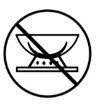

Do not place cookware improperly or unevenly on the pan support, as it may cause the cookware to tip over.

Only use wok (chinese pan) supports recommended by Rinnai

Do not place objects such as flame covers or asbestos mats between the cookware and the pan support, as this may damage the stove
4. What is the ideal distance between a built-in hob and a cooker hood?
| Slim | Chimney |
| Electric Stove: 55-60 cm | Electric Stove: 60-70 cm |
| Gas Stove: 60-70 cm | Gas Stove: 80-90 cm |
Before installation, it is recommended to read the user manual carefully, as the installation distance may vary depending on the product type.
5. What should I do if the burner does not ignite?
Please check and replace the battery located at the bottom of the stove (DC 1.5V battery, size C or D depending on the model). If the burner still does not ignite, please contact the Rinnai Service Center.
* Remove the battery if the stove will not be used for an extended period of time.
6. Can a built-in hob use LNG (Liquefied Natural Gas)?
Yes, all Rinnai built-in hobs can use LNG as a gas source by purchasing an additional injector (spuyer) and having it replaced at a Rinnai Service Center.
- Portable Gas Stoves: Must be brought directly to the service center, whether the product is under warranty or not.
- Built-in Hobs: Free service visit if the product is still under warranty; service fees apply if the warranty has expired.
Service fee: IDR 83,250
Transportation fee: IDR 20,000
Injector (spuyer) price by model:
RB-712/713: IDR 11,100
RB-2GH: IDR 8,880
RB-72: IDR 11,100
- Induction Stoves:
Service fee: IDR 111,000
Transportation fee: IDR 20,000
(Spare parts not included)
- Cooker Hoods:
Service fee: IDR 111,000
Transportation fee: IDR 20,000
(Spare parts not included)
- Water Heaters (Below 100 Liters):
Free service visit if under warranty; otherwise:
Service fee: IDR 111,000
Transportation fee: IDR 20,000
(Spare parts not included)
- Water Heaters (Above 100 Liters):
Free service visit if under warranty; otherwise:
Service fee: IDR 222,000
Transportation fee: IDR 20,000
(Spare parts not included)
7. What is the maximum safe usage duration for a built-in hob?
For daily use, it is recommended not to exceed 8 hours.
Glass built-in hobs are designed for household use and are not recommended for commercial purposes such as catering, food stalls, or restaurants.
8. What happens if a built-in hob does not have a safety device?
A safety device functions to prevent gas leakage in the event that the flame is extinguished due to wind or food spills. Without a safety device, the risk of gas leakage is significantly higher.
To minimize this risk, Rinnai incorporates safety device technology in most of its built-in hobs. For models that are not equipped with a safety device, Rinnai designs ventilation holes in the lower body of the hob to allow sufficient oxygen intake, ensuring safer combustion during use.
9. What is the ideal cookware size for a tempered glass hob?
It is safe to use most cookware sizes, except for BBQ plates and conventional oven pans (stove-top oven)
10. What type of stainless steel is used for the product?
Built-in hobs and cooker hoods use Stainless Steel SUS 304, while portable stoves use Stainless Steel SUS 430.
11. Why does the flame on my stove turn yellow?
A yellow flame indicates incomplete combustion, which may be caused by a dirty burner or poor air circulation in the room.
12. What types of burner designs are available on Rinnai built-in hobs?
Rinnai built-in hobs feature three types of burner layouts:
- Unique Shape
Designed to suit Asian cooking habits. The left burner is intended for large pots and wok cooking, while the two burners on the right are positioned diagonally, allowing simultaneous use with smaller cookware.
Examples: RB-93UG, RB-3SS-C
- Mountain Shape
Inspired by a mountain-like layout. This design allows the use of two large pots on the left and right, with a smaller pot in the center. Recommended for European-style cooking, which typically involves multiple smaller portions.
Examples: RB-773RO(G), RB-7513D(G)
- T-Shape
Features one large burner and two smaller burners (top and bottom). The overall size is more compact compared to other layouts, making it suitable for everyday use in limited spaces.
13. Why do both igniters click at the same time even when only one knob is turned?
Rinnai uses a parallel ignition system, where both igniters operate simultaneously, but only the burner corresponding to the turned knob will ignite.
(Except for models RB-782/783G(B) and RB-772/773RO(G))
14. How do I clean and maintain a built-in hob?
Proper maintenance is simple. For long-term use, regular cleaning is recommended by following these guidelines:
- Do not clean the hob immediately after cooking; wait until it has cooled down
- Clean using warm water mixed with a small amount of mild detergent applied to a soft sponge
- Use a toothbrush or soft scrub sponge for stubborn dirt
- Ensure that the burner ports are completely dry after cleaning
- To avoid damage, do not use cleaning agents containing soda, alkali, ammonia, acid, or chloride, solvent-based cleaners, stain/rust removers, or abrasive cleaners (such as powder or cream cleaners)
15. What is the ideal clearance if a built-in oven is installed below the hob?
Please ensure proper spacing as follows
- Distance between hob and oven: 30 mm (3 cm)
- Distance between oven and side/back walls: 45 mm (4.5 cm)
- Distance between oven and cabinet (if no hob above): minimum 50 mm (5 cm) for ventilation
16. Which built-in hob is recommended for a minimalist apartment?
For apartment living, the Domino Series is recommended, including models RB-311N(GB), RB-312N(GB), RB-3311S(GBS), and RB-3312S(GBS).
These models are available in 1- and 2-burner variants, feature compact dimensions (31 x 52 x 13 cm), and have a vertical design suitable for limited spaces.
17. What is Rinnai’s best-selling built-in hob?
The RB-72G is one of Rinnai’s best-selling built-in hobs due to several advantages:
- Part of the Ideal Hob Series, with dimensions suitable for typical household use (77 x 46 x 14.7 cm)
- Strong and stable flame power of 4.3 kW
- Burner head made of hot-forged brass with ceramic coating, making it more durable and resistant to discoloration
18. Which Rinnai built-in hobs are gas-efficient?
- RB-772RO(G): 2 burners with gas consumption of 3.2–3.2 kW
- RB-773RO(G): 3 burners with gas consumption of 3.2–1.2–3.2 kW
19. What is the function of the aluminum frame in models RB-7512D(B) and RB-7513D(B)?
These models feature an aluminum frame with a Top Air Intake System. This system draws oxygen from the top of the hob, helping to maintain a stable flame even when the cabinet door below is open, and reducing the risk of flame extinguishing.
They also use a combination of an aluminum frame and 8 mm thick glass.
20. What are the advantages of the Rinnai RB-93UG?
The RB-93UG is a 3-burner built-in hob with two high-power burners and one medium burner, with gas consumption of 4.3 kW – 4.3 kW – 1.7 kW.
The burner heads are made of brass with a ceramic coating, making them easier to clean and more durable. The pan supports and wok adaptors are made of cast iron.
21. What is the ideal lifespan of a built-in hob?
There is no fixed usage limit as long as the product is used properly in accordance with the user manual. Based on user experience, built-in hobs can remain safe to use even after 8–10 years of use.
Induction Hob & Vitroceramic
1. What are the differences between induction hob and vitroceramic?
There are several differences between these two types of electric cooktops, such as:
- Heating Method
Vitroceramic: Uses heating elements; the burner surface glows red and becomes hot
Induction: Uses electromagnetic induction; the surface does not glow red and only becomes warm
- Cookware Compatibility
Vitroceramic: Can use various types of cookware as long as the base is flat and heat-conductive (e.g., iron or aluminum)
Induction: Requires specific cookware that is compatible with electromagnetic induction (has an induction base)
2. What are the advantages of induction and vitroceramic cooktops?
The advantages of these Rinnai cooktops compared to other brands include:
- Equipped with a Child Lock Safety Device to minimize accidents caused by unintended use
- Uses high-quality glass from Schott Germany, backed by a lifetime warranty
- Features a Residual Heat Warning system that alerts users when the cooktop surface is still hot
3. How do I choose the right cookware for an induction cooktop?
Before using an induction cooktop, please consider the following recommendations when selecting suitable cookware:
- Use cookware made of magnetic materials or specifically designed for induction cooktops
- Recommended materials include enamel-coated steel or cast iron
- Not recommended: cookware made of non-magnetic stainless steel, aluminum, glass, ceramic, or clay
- Choose cookware size that matches the burner size, such as:
| Burner size(cm) | The minimum cookware size that is safe to use (cm) |
| 16 | 12 |
| 18 | 14 |
| 21 | 18 |
4. What is the maximum load capacity when using an induction stove?
- 3011, 3022 & 5022 : 60 kg
- 7012 & 7013 : 80 kg
- 6024 : 100 kg
* Applicable to induction and vitroceramic cooktops, with glass covered by a lifetime warranty.
5. How do I determine a safe power level when using an induction cooktop?
Rinnai induction cooktops are equipped with power levels from 1 to 9, allowing you to adjust the heat according to your cooking needs.
For safety, the cooktop is designed with an automatic shut-off feature that will turn the unit off if it is used continuously for a certain period of time.
| Power Level | Cooking Zone Power Automatic Switch-Off |
| 1,2,3 | 8 Hours |
| 4,5,6 | 4 Hours |
| 7,8,9 | 2 Hours |
6. How do I determine the appropriate power level for use?
The following is a usage guide based on power levels on an induction stove:
|
Power Level |
Cooking method |
Suitable for: |
| 1-2 |
|
|
| 2-3 |
|
|
| 3-4 |
|
|
| 4-5 |
|
|
| 6-7 |
|
|
| 7-8 |
|
|
| 8-9 |
|
|
7. How do I maintain and clean an induction cooktop after use?
- Allow the cooktop to cool down to room temperature
- Use a soft cloth to dry the surface after cleaning with water (to prevent water stains)
- Use cleaning products specifically designed for ceramic, steel, or stainless steel surfaces
Cooker Hood
1. Why should I use a cooker hood?
Using a cooker hood is highly recommended for the following reasons:
- Filters air and smoke from cooking to keep the room air clean and healthy
- Removes heat and steam to prevent the kitchen from becoming stuffy
- Allows cooking at any time, as Rinnai cooker hoods are equipped with built-in lighting
- Enhances the kitchen’s appearance, making it more elegant and modern
2. Can a cooker hood eliminate odors in the room?
Rinnai cooker hood technology can reduce odors in the room by approximately 80–90%.
3. What is the difference between chimney series and slim series cooker hoods?
Chimney series is designed for larger and more spacious kitchens, while slim series is suitable for smaller or minimalist kitchens.
4. How does the exhaust system of a Rinnai cooker hood work?
All Rinnai cooker hoods offer two exhaust modes, ventilation and recycle.
Ventilation: suitable for kitchens with poor air circulation (expels air outside)
Recycle: suitable for kitchens that are rarely used or dry kitchens; works by filtering and recirculating cleaner air back into the room
5. What causes a decrease in suction power?
Dirty aluminum or charcoal filters need to be replaced. For models using baffle filters, the filters can be cleaned. Replacement or cleaning is recommended every 6–12 months.
6. What is the maximum distance between the cooker hood and the exhaust outlet?
The maximum distance is 10 meters, with a maximum of 2 bends in the ducting pipe.
7. What pipe diameter is required for a flexible cooker hood duct?
The required diameter varies depending on the type of cooker hood, whether slim or chimney. Slim type requires a 5-inch diameter with a pipe length of 40 cm, while Chimney type requires a 6-inch diameter with a pipe length of 40 cm
8. How can I measure the noise level of a cooker hood?
You can measure it using a Sound Level Meter (SPL Meter).
9. What is Rinnai’s best-selling cooker hood?
The RH-S3059-PBW is one of Rinnai’s best-selling models due to its slim design, strong suction power (up to 600 m³/h), and LED lighting with LED strip for better visibility.
10. Which Chimney Series model offers low noise with strong suction power?
The RH-KT2959-GBV features low noise operation with strong suction power up to 1,300 m³/h and power consumption of 220 watt.
11. What is the suction capacity of Rinnai cooker hoods?
Slim: 220–600 m³/h
Chimney: 1.000–1.300 m³/h
12. Which T-Shape model has high suction power?
RH-C2859-SSW offers suction power up to 1,200 m³/h.
13. Is a charcoal filter required for a cooker hood?
A charcoal filter is required when using the Recycle system. It is not needed for the Ventilation system. For example, RH-KT2959-GBV does not require a charcoal filter as it only supports ventilation.
14. How do I clean the RH-KT2559-PBW cooker hood?
- Clean the baffle filter and oil pack by soaking them in hot water, then gently scrub with a toothbrush
- Check the charcoal filter. If it becomes sticky and no longer makes a sound, it should be replaced
15. What are the advantages of a plasma filter in a pendant hood?
Plasma filter technology can remove up to 98% of odors, smoke, allergens, and pollutants from cooking. It effectively eliminates grease particles in the air, ensuring cleaner and fresher air circulation.
16. What is the difference between plasma fresh and plasma cluster?
Plasma fresh: absorbs, purifies, and releases clean air back into the room
Plasma cluster: Emits positive and negative ions to remove odors, bacteria, mold, allergens, and reduce viruses.
17. What is the function of the 16-layer aluminum filter?
It filters oil residues, smoke, and airborne particles.
18. What is the meaning of 'delay time' in a pendant hood?
This feature allows the hood to continue operating for a few minutes after being turned off, then automatically shuts down. It ensures that remaining smoke, odors, and steam are fully extracted.
19. How long does the delay timer operate?
- Level 1: 5 minutes
- Level 2: 10 minutes
- Level 3: 15 minutes
- Level 4: 20 minutes
Water Heater
1. What is the difference between an electric water heater and a gas water heater?
An electric water heater uses electrical power as its heat source and can store water in a tank, while a gas water heater uses gas (LPG) as its heat source, and the hot water is distributed directly to the tap without being mixed with cold water.
2. What needs to be prepared before buying a water heater?
- Prepare a piping line in the bathroom for water circulation, which must use special pipes that can withstand high temperatures.
- Make sure the water pressure is suitable. If the pressure is low, use a booster pump.
3. What accessories need to be prepared for installing a water heater?
- Flexible hoses (1 for hot water & 1 for cold water)
- Double napple
- Stop valve
- Mixing valve (faucet)
- Gas regulator & hose (for gas water heaters)
- Power outlet (for electric water heaters)
Electric Water Heater
1. What accessories are included when purchasing an electric water heater?
- 1 Pcs drain hose 800 ml for drainage
- 1 Pcs mounting bracket
- 2 Pcs screw (8×60 mm) + fisher
- 1 Set safety valve + gasket, functions as a one-way valve (allows water to enter but prevents it from flowing back out), regulates the pressure inside the tank to below 0.8 kPa, and serves as a drain outlet for emptying water from the tank.
2. How do I determine the required water heater capacity (in liters)?
10 – 15 L : 1 person
30 L : 1-2 people
40 L : 2 people
50 L : 3 people
80 L : 4-5 people
100 L : 5-6 people
140 L : 6-8 people
* bathtub requires a minimum capacity of 80 liters.
3. How long does it take for an electric water heater to refill after use?
The estimated refill/reheating time is 1–3 hours, depending on the tank capacity and the power rating of the water heater.
4. Can an electric water heater be used for more than one bathroom at the same time?
Yes, it can be used for multiple bathrooms simultaneously by choosing a capacity of 40–100 liters, with the following considerations:
- Installation should be outside the bathroom and supported by a booster pump to ensure stable water flow
- The water temperature may decrease depending on the pipe distance; the longer the distance, the lower the heat at the outlet
- Tank capacity should be selected based on the number of bathrooms and estimated usage, approximately 10–15 liters per person per use
5. What is the difference between the Ultimate Series RES-EC and Gold Series RES-A?
- The Gold Series features gold-colored details, giving a more luxurious and elegant appearance
- Equipped with AG+ technology at the inlet and outlet, which helps eliminate bacteria and harmful germs, making the water cleaner and safer
- Inner tank material of RES-EC is Titanium Enamel, while RES-A is Sapphire Enamel.
6. Will the water heater leak if the water pressure is too high?
Every Rinnai water heater is equipped with an Overpressure Safety Device, which helps maintain stable water pressure.
With this feature, Rinnai water heaters can withstand pressure up to 7 bar. If the pressure exceeds 7 bar, the system will automatically reduce it to a safe level.
Gas Water Heater
1. How do I safely install a gas water heater?
- If installed inside a bathroom, use a flexible pipe to vent combustion exhaust to the outside
- It is recommended to install the unit and gas supply outside the bathroom, under a roof to protect it from rain
2. Why should I use a Rinnai gas water heater?
Rinnai gas water heaters offer several advantages, including:
- Direct shower: Produces hot water instantly without mixing with cold water
- Anti-leaking gas sensor: Cuts off the gas supply if the burner flame suddenly goes out, preventing gas leakage
- Overheat thermostat: Prevents overheating with a maximum temperature of 75°C
- Over pressure safety device: Protects against excessive water pressure (up to 7 bar)
- Safety timer: Automatically turns off the water heater every 20 minutes
3. What is the difference between REU-5CFC and REU-5CFM gas water heaters?
- REU-5CFC: Operates at low water pressure (0.15–0.2 bar) and features an LCD display
- REU-5CFM: Operates at very low detected water pressure (0.04–0.17 bar)
4. What are the functions of the knobs on CFC & CFM models?
-
- CFC model: Equipped with 3 knobs
- CFM model: Equipped with 1 flame knob and 2 control knobs (water & temperature), as follows:
I: Hot
II: Warm
- Flame Knob (Flame Control)
Min: I -> Minimum Heat *II
Max: III -> Maximum Heat*I
- Water Volume (Water Flow Control)
Min -> Low Water Flow*I
Max -> High Water Flow *II
- Temperature Knob (Temperature Control)
Min -> Lower Temperature *II
Max -> Higher Temperature*I
5. Which water heater is suitable for 2 bathrooms and simultaneous use?
REU-10CF (10 liter) or REU-15CF (15 liter)
Oven
1. What are the advantages of Rinnai ovens?
- Large capacity of up to 70 liters
- Equipped with 8 cooking modes
- Interior oven light for better visibility
- Conventional heating for cooking and baking
- Fan-assisted grilling for even browning
- Bottom heating with fan for consistent heat distribution
- Top heating function
- Defrost function for frozen food
- Full surface grill for wider heating coverage
- Hot air circulation for even baking results
- Digital timer with automatic end-cooking feature
- Cooling fan to prevent overheating
- Auto safety switch-off for added safety
Table-top Stove
1. What do the flame colors on a gas stove mean?
low are the common flame colors you may find on a Rinnai gas stove
- Blue: Indicates proper combustion and is safe for use
- Yellow: Indicates incomplete combustion, usually caused by insufficient oxygen or a dirty burner
- Red: Typically caused by dust covering the burner or high humidity in the environment
- Green: Indicates the presence of certain chemicals during combustion (e.g., vinegar or cleaning agents)
2. What factors contribute to more efficient gas consumption?
- A flame shape designed to go straight upward rather than spreading sideways
- Smaller burner diameter
- Shorter distance between the burner and the cookware
- Using appropriately sized (smaller) cookware
3. Can I replace the burner with a different type of burner?
Yes, however, replacement is only possible for certain models, namely 511, 522, 302, and 602. The burner is not included in the purchase package and must be purchased separately through a Rinnai Service Center.
For stoves with a ceflon-coated body, replacing it with a high-power burner may cause the body to wear out more easily. Therefore, it is more recommended for stoves with a stainless steel body.
For models other than those mentioned, burner replacement is not possible due to differences in spare part dimensions and incompatible input, which may result in unstable flames.
4. What is the maximum load capacity when using a gas stove?
Each burner can support up to 25 kg. Therefore, the total maximum load for a two-burner gas stove is 50 kg.
5. What are the differences between TL-287RI and TL-289RI?
The difference between the two products is based on gas consumption.
- Gas consumption of TL-287RI: 6.2 kW
- Gas consumption of TL-289RI: 9.8 kW
6. What are the differences between RI-522A and RI-522AT?
The most significant difference is that the RI-522AT is equipped with a timer feature, while the RI-522A does not.
The timer can be set from 5 to 60 minutes and functions as a reminder. To use it, turn the knob one full rotation clockwise, then turn it back to the desired time setting. This method helps produce a longer timer alert sound.